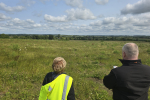
Richard recently visited the proposed site for East Park Energy and spoke to a number of residents about their concerns with this solar plant.
Richard Fuller MP said:
I enjoyed speaking with a number of local residents during my most recent visit to Little Staughton and you can see the whole video of my conversations at https://youtu.be/l_K5_YuDuqI
All of them raised legitimate concerns about the proposed East Park Energy scheme. No-one I spoke to was against solar energy generation in general, but the sheer scale of this 1,900 acre proposal, coupled with the fact that three quarters of its footprint is best and most versatile agricultural land, makes it a wholly inappropriate scheme that should be rejected.
Loss of Agricultural Land
Successive governments have repeatedly said that wherever possible, best and most versatile agricultural land should not be used for ground solar installations. Why then has the East Park Energy proposal not be rejected out of hand given that 74% of it's footprint is just such high quality farmland.
Congestion
It's a real concern that a solar plant of this size will necessitate substantial HGV and other vehicular access for a considerable amount of time. As Emma outlined, the local roads around the proposed site are simply not designed to handle such traffic and disruption and potential risks to local residents are genuine worries.
Impact on footpaths and bridleways and the Duke of Edinburgh Scheme
It's not been widely discussed but Elaine raises some very good points about the 23 footpaths and 7 bridleways that would be compromised by the proposed 1,900 acre East Park Energy solar installation, including their links to much wider networks.
I also hadn't fully appreciated the lack of amenity for the Duke of Edinburgh Award Scheme that this development would create. This scheme has taught important life skills to so many schoolchildren down the years and it would be very sad if aspects of this experience would be denied future cohorts.
Financial stability of the developer
There's no reason to doubt the financial stability of the developer involved with East Park Energy, however, we have seen situations in the past, and on other schemes, where the initial investor does not complete the project for a variety of reasons. Even worse than 1,900 acres covered in steel and glass would be a half-completed but neglected building site with partially built structures blighting the countryside.
There's also the issue of funds to return the land to its current state at the end of the 40-year lease. I believe there's a strong argument to be made that any developer of a scheme like this should be mandated to create and maintain an escrow fund to cover possible costs in the future. This would protect local residents against the risk of being left with unsightly 'stranded assets' if investors decide to change plans, and would also ensure that funding is readily available to 'make good' the land at project's end.
Energy generation and failures of battery energy storage systems
It was quite sobering to hear just how little electricity the East Park Energy solar proposal will generate for each of the 100,000 homes that it will supposedly power.
It's also worth noting that this will only be 'renewable' energy on sunny days, predominantly during the summer months. In winter and when there is little or no sunshine, the promised electricity will most likely be generated by gas or nuclear.
Failures of battery energy storage systems (BESS) are rare but certainly not unheard of, and when they do happen the impact can be significant.
Nick raised some very important concerns that, in his opinion, neither the developer nor the examining authority have done sufficient due diligence on the risks posed by the BESS proposed by East Park Energy. It seems obvious that as a minimum there needs to be a comprehensive risk assessment carried out and contingency plans developed to deal with the unlikely event of a battery meltdown.
Meeting with these residents, I was struck by the impact this project could have on their daily lives if it goes ahead. They are certainly not NIMBYs and most recognise the importance of taking steps to decarbonise our power supplies. What they cannot understand is why pristine countryside and highly productive arable farmland would be permanently sacrificed on such an enormous scale when far better options including rooftop solar are being dismissed.